
“The Robots are Here”.
Digital entrepreneur Brian Clark summed it up perfectly in the subject line of his newsletter about ChatGPT, a generative artificial intelligence (AI) chatbot that enables users to simulate human-like conversations with an AI application.
As one of the hottest trending tools in the digital space right now, business owners and marketers alike are curious about the possibilities ChatGPT holds for their businesses and clients.
- What impact will this technology have on the marketing industry?
- Will it revolutionise marketing strategies and customer experiences?
- How can businesses leverage this tool to their advantage in the near future?
Even Hollywood A-lister Ryan Reynolds is talking about AI’s potential in his latest ad for Mint Mobile, the mobile network he part owns.
In this post, we’ll tackle these questions by summarising the thoughts of some prominent marketers and thought leaders on the potential and limitations of ChatGPT.
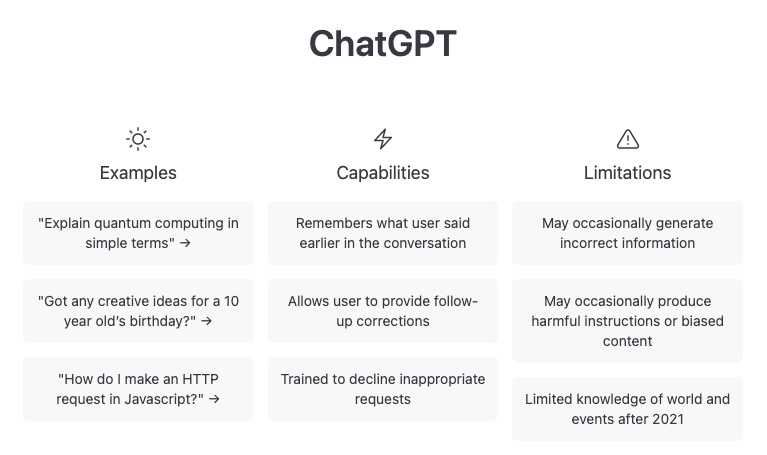
The ChatGPT interface
Anne Handley: ‘Who is holding the tool?’
Digital marketing pioneer Ann Handley stresses the point that AI doesn’t really work on its own steam.
“You can’t put AI in the hands of someone who can’t write and expect anything other than mediocre,” she writes.
“It requires discerning people who care. It needs discerning people who care.”
According to Handley, the way to use AI is as a gymnast using a spotter and a coach.
“AI can help you create with more confidence and without fear, but it’s your talent that drives AI.” – Anne Handley
Mark Schaefer: ‘A threat to creators’
Schaefer believes that ChatGPT and other such bots are an “existential threat to many creators”.
In his newsletter, he cites an example where an AI bot scraped original content from a website and then used ChatGPT to rewrite the copy just enough to make it seem original.
Schaefer says this isn’t much different from the old “black hat” SEO technique of scraping excellent content from other websites and republishing without permission.
His solution? “Working on your personal brand and the meaningful, emotional connection with your audience is the ONLY thing that can save you,” he says.
That said, Schaefer notes he recently earned his first income from a search enquiry via ChatGPT. This prompted him to wonder about the role of SEO in the ChatGPT world.

Brian Clark: ‘AI is a game changer’
Echoing Schaefer, Clark believes “AI will completely change the nature of search engines, social media, content creation and more.”
He says the fact that you can now see for yourself what this tool can do – especially when it comes to creating content – makes how we use it (strategy) all the more important.
“But the right content, for the right people, with the right offer? That’s what always works … but it requires an all-new strategic approach in 2023 and beyond.”
Omar H. Fares: ‘Humans are irreplaceable’
Fares shares Handley’s take on ChatGPT, predicting a supporting role for the marketer, saying it cannot replace the human factor in marketing in its current form.
Specifically, he sees it being used to support content creation, enhance customer service, automate repetitive tasks and support data analysis.
He suggests the following possible uses:
- Editing written text
- Make suggestions
- Summarise ideas
- Improve readability of text
- Enhance SEO by examining keywords
“Businesses should only use the technology as a tool to assist humans, not replace them.” – Omar H. Fares
He says humans will still play a role in checking outputs and creating marketing messages that are consistent with the company’s strategy and vision.

Rupam Deb: ‘Keywords, code and copy’
Deb lists a host of benefits that ChatGPT holds for businesses, including quick response times, content creation, research and content curation, and customer engagement.
He believes that its capabilities will be a big win for digital marketers, particularly when it comes to producing synonyms for root keywords.
Marketers can use these suggestions in landing pages, blog posts, pay-per-click campaigns, and on-page SEO.
Donovan Banks: ‘Experienced marketers can see the flaws’
Banks, the owner of a social media marketing agency, has started using ChatGPT as a tool to help him write social media posts when “writer’s block sets in.”
He stresses that at this early stage, it is “a tool, not a worker”, much like Handley and Fares do.
In much the same way as people notice stock imagery used in ads, Banks reckons they will soon be able to discern the use of AI-generated copy in marketing messages.
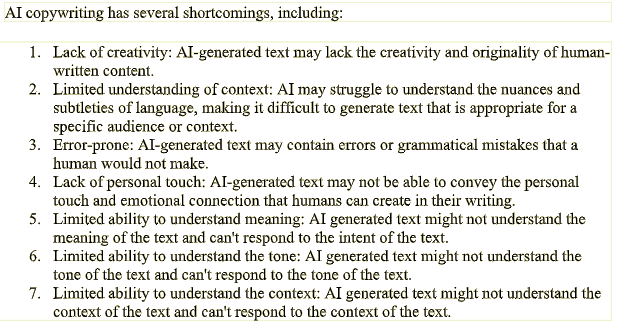
The lack of a “human touch” is apparent in the text produced by ChatGPT, he says.
And marketers seeking to make an impact will “have to make an effort to prove they are human.”
Andy Crestodina: ‘Differentiation matters more than ever’
Crestodina, a renowned speaker and digital marketing professional, sees ChatGPT as providing some competition for Google. This is because it also provides answers to questions in simple language.
As a result, he predicts a negative impact on SEOs if their content strategy is to provide short answers to common questions.
Crestodina believes that ultimately writers who know their subject matter and their audience well – who go “deep into topics with research and visuals – will still have plenty of organic traffic.”
For him, the impact of ChatGPT will place greater importance on differentiation.

Martin Waxman: ‘Pay attention to the glitches’
Citing author and computer scientist Janelle Shane, Waxman says that AI outputs are “simply word predictions based on content created in the past”.
And this is why the results can seem so familiar and generic.
But by spotting the errors and glitches and getting ideas from this, marketers can use AI as an assistant that “sparks human ingenuity”.
Waxman recommends posing tough questions and expecting reasonable answers when using ChatGPT.
He also suggests checking the AI-generated copy carefully as you may be spreading lies and misinformation if the text gets published without review.
Select Web’s view
The robots aren’t even knocking at the door any more. They are here. And they’re here to stay.
The question is: how should we approach the adoption of generative AI in our working lives?
- What do we need to consider?
- Should we totally commit?
In these early stages, it seems like there are more questions than answers.
At Select Web, our content is created by humans, for humans. We believe a company’s “brand voice” is integral to its identity.
We have concerns that a company that uses ChatGPT at this early stage may be underwhelmed by the results.
What makes them special and unique to their target audience will be lost in the generic blandness.
In the same way that Waxman signed up for social media early but took a long time to get up the nerve to post, we’re going to take a bit of a back seat before going in boots and all with ChatGPT.
We’re going to keep the robots at bay as long as we can . . .
• Looking for copywriting that speaks to your target audience in a uniquely human way? Contact us
• Have you started using ChatGPT in your business yet? Share your stories on our socials